|
Wagler's Pit Viper The
Wagler's pit viper lives in trees of the Southeast
Asian rainforest. The climate in the rainforest is
wet and humid and it rains a lot. During the wet
season, or monsoon season, it usually rains every
day. The rainforest temperature during the day
varies very little and is about 96°
Fahrenheit. The nights are cooler than the day
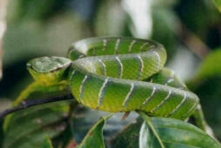
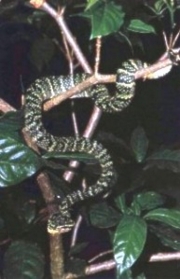
time, with temperatures averaging about Wagler's pit viper is a medium sized viper which can grow up to 4 feet in length. It is called a pit viper because they have pits just behind the nostrils which contain special organs that can sense heat and locate warm-blooded animals. This is an important adaptation since Wagler's pit viper is nocturnal and hunts at night. It is an arboreal species, which means it lives in trees. The adult male is green, with a black border and many greenish-yellow crossbars on its back. The young viper changes its color as it grows. The young are all green with spots of white and red. The spots are sometimes arranged in pale crossbars. The adult
female goes through four different phases named:
The Malaysian phase, the Sulawesi phase, the
Kalimantan, and the Philippine phase. During these
phases, the snakes are a wide variety of colors and
sizes. For example: most pit vipers can grow to be
larger than 40". But in the Philippine phase the
snake is smaller and usually doesn't grow any
bigger than 20". In the Malaysian phase, the snake
has a black background with yellow bars across it's
back, a yellow belly and green spots, one on each
scale. In the Sulawesi phase, the viper has a green
background with blue bars and white across the back
and a cream and blue belly. It also has a blue
stripe from the nostril through the eye. In the
Kalimantan phase, the snake has a yellow background
with bright blue bars across the back. Its belly is
shades of green and cream. The last phase is
called Pit vipers are viviparous, which means their babies are born live (no eggs). The eggs open inside the mother's body. One of the advantages of this is that the eggs are better protected than eggs that are hatched on the ground. The number of snakes born in a litter ranges from 6 to 50. All babies are able to look after themselves as soon as they are born. Venomous snakes have fangs already loaded with venom and poison as soon as they are born. The Wagler's pit viper is a carnivore. That means that they eat other animals. They hunt at night. The adult feeds on lizards, birds, and rodents. Snakes in the tropics don't need to use food energy to keep themselves warm. Snakes can also get all the energy they need with just 3 meals a month. Vipers have a pair of hollow fangs. They lie up against the roof of the mouth and shoot out when the viper strikes. The venom of Wagler's pit viper attacks red blood cells and their ability to carry oxygen, as opposed to attacking the nervous system. One of the predators of the viper is the King Cobra. The pit viper preys on animals such as mice, lizards, and birds. The young pit vipers prey on animals such as rodents, small birds, and an occasional frog. The pit viper is not endangered. by Dylan C. 2002
bibliography: Photo Credit - scanned by sChuah Eng Hoe Martisson, Chris, "The Classification of Snakes". The Encyclopedia of Snakes, p. 247.1995, New York. The Columbia Electronic Encyclopedia, 6th edition, 2000, Columbia University Press. Lacina, Scott. "Wagler's Viper Page.", http://www.kingsnake.com/viper/history.html (11/5/01) "Focus on Wildlife: Wagler's pit viper - Tropidolaemus wagleri", http://www.ecologyasia.com/Vertebrates/waglers_pit_viper.htm. (11/6/01). "Pit Viper", http://infoplease.kids.lycos.com/ce6/sci/AO839232.html, (11/7/01). "Pit Viper", http://www.dep.state.pa.us/dep/deputate/minres/dms/website/firstaid/pit viper, (11/7/01). "NOVA Online | Night Creatures of the Kalahari | pit viper", http://www.pbs.org/wgbh/nova/kalahari/pitviper.html, (11/7/01).
|