|
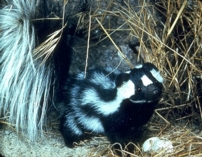
Spotted Skunk The western
spotted skunk is an animal that lives in the
chaparral biome of southwestern California and in
areas in between Costa Rica and British Colombia,
Canada. It prefers the desert, woods, brush land,
and rocky terrain. It avoids the dense forests and
wetlands. This animal can live in a variety of
temperatures. The western spotted skunk builds a
den out of a hole in the ground and lines it with
leaves. Occasionally a spotted skunk will live in a
hollow tree. All skunks can spray their predators. They have 2 anal glands that are filled with musk. When a skunk sprays, it squeezes the anal glands together and the musk comes out an anal opening. However, there is a process the skunk goes through before spraying its enemy. The skunk first gives a warning by stamping its front paws. If the intruder pays no heed, the spotted skunk then stands stiff and struts around. It then stands on its front paws and waves its rear end in the air. After that, the skunk sprays its enemy. The musk can linger on the same spot for days. Most animals take the hint and stay away from the skunk after they've been sprayed once. Also, skunks can swim, but they swim only when their life is threatened. The western spotted skunk mates in October and gives birth in March or April the following year. However, both sets of birth times vary due to the fact that female skunks can delay the birth date until the food is plentiful. Mother skunks give birth to about 6 pups at a time. A skunk's gestation period is 50-65 days, longer with implantation. They reach sexual maturity at 4-5 months. Their birth interval is 2 years. For the first 8 weeks baby skunks feed off their mother's milk. After they have been weaned, the mother brings her young live prey, and eventually teaches them to hunt for themselves. A pup's father does not play a huge role in its life cycle, staying solitary in the summer, and occasionally sleeping with the mother and pups in the winter. Skunks do not truly hibernate. The pups have musk glands when they are 1 month old. They reach full size at 4 months. Skunks live up to 10 years in captivity. A normal spotted skunk's diet in the winter consists of mainly rats and other rodents. However, in the summer, the skunk's diet changes to more vegetation and insects. The skunks normally eat small mammals along with these. In the autumn, a skunk adds fruit and berries to its diet. In the winter, the skunk goes back to its original favorite prey, small mammals. The spotted skunk's prey is mainly small mammals such as rats and mice. The spotted skunk has no normal predators as it shoots its musk to defend itself. However, great horned owls and bobcats have been known to attack them. Skunks are especially helpful to humans by catching rodents quite frequently. Spotted skunks are common animals and are not considered endangered. Spotted skunks are plentiful, occupying most of their habitat pretty densely. by Will O. 2002
bibliography: Photo Credit: Alden M. Johnson. Copyright 1999 California Academy of Sciences. Kauffman, John H. and Kauffman, Arleen B. World Book (17) "Skunk" p. 496 2001 "Spotted Skunk", Wildlife Explorer, International Masters Publishers ©1998 "Western Spotted Skunk," http://www.enature.com (2002).
|