|
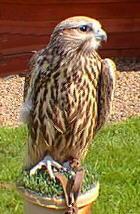
Saker Falcon The saker
falcon is a big, strong bird of prey with large
feet and pointed wings. It is larger than the
peregrine falcon, and has a very wide wingspan for
its size. There are several subspecies of saker
falcons; the steppe Saker (Falco cherrug cherrug),
the mountain Saker (Falco cherrug milvipes), and
the Altai Saker (Falco cherrug altaicus ). The
saker falcon has a large range of color, from dark
brown to grey, to almost white. Saker falcons are
also thought to breed with gyrfalcons and form a
hybrid falcon. The saker
falcon originated in southeast Europe and Asia.
Their preferred habitats are the open plains and
forest steppes. They can be found on the steppes of
Mongolia and of southern
Siberia, and the Russian Altai mountains.
The saker
falcon is about 18 inches tall. They have large
eyes and a short, hooked beak. Steppe saker falcons
use the nests of Black Kites (Milvus migrans) and
Imperial Eagles (Aquila heliaca). The mountain
saker build its nest on cliffs. Saker falcons lay 2
to 5 eggs. In the winter they migrate south to
Kazakhstan and the Middle East. They spent
most of their time hunting for mammals like voles,
rats, stoats, weasels, northern pikas, Siberian
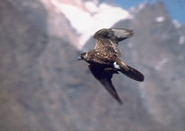
chipmunks, and birds. They dive for their prey at
200 mph. The saker falcon are ferocious hunters and
often attacks prey that is bigger than itself.
Female saker falcons are more ferocious than the
males and are preferred by falconers. In the wild
they have no natural enemies, except man.
The larger,
dark brown and gray barred Altai Saker falcons are
the favorite bird of Arab falconers. Many of the
birds are trapped in Arab countries when they are
on their migration to the Middle East. In the past
it was the custom to capture juvenile female sakers
and train them to hunt because they were easier to
train than adult birds. Because the
birds have become scarce, both adult and juvenile
birds are now being caught throughout Asia and sold
to the Middle Eastern falcon market. Without
breeding adults in the wild, the saker falcon's
population is in danger of declining. There are
no accurate figures for the population of Saker
falcons, but it is believed that there are only
1,000 pairs of birds left in Russia, and 130 pairs
in the rest of Europe. Some scientists think the
decline of the steppe Saker is caused by the
regional extinction of their preferred prey, the
Red-cheeked Sousliks (Citellus erythrogenys), which
is a type of ground squirrel. Global temperature
changes has brought about changes in the vegetation
on which the sousliks survived. Because the climate
changed, the plants which Sousliks ate died, which
caused the Sousliks to die off in that region,
which is causing the Steppe Saker falcon population
to decline. There are only about 200 pairs of
Steppe Saker falcons left and they may become
extinct in the next 10 to 15 years. 2000
bibliography: "Mongolian Steppe", http://www.fonz.org/zoogoer/zgl1997/mongolian.htm, (June '00). "Saker Falcon", http://www.discoverit.co.uk/falconry/saker/htm, (June '00) "Research", http://www.gyrfalcon.co.uk/FFI_research.htm, (Aug '02) Eastham, Chris, "saker falcon paper", http://www.gyrfalcon.co.uk/Saker%20falcon%20- %20its%20use%20in%20arabic%20falconry%20and%20conservation.htm, (Aug '02). Eastham, Chris, "saker falcon paper 2", http://www.gyrfalcon.co.uk/What%20is%20an%20altai%20falcon.htm,(Aug '02). "Altay Saker", http://www.falcons.co.uk/MEFRG/Falco/16/Altay.htm |