|
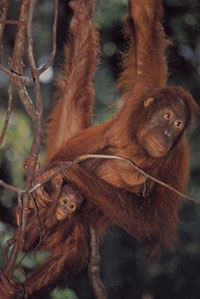
Orangutan Orangutans
live in the tree tops of the Southeast Asian
tropical rainforests of Sumatra and Borneo. They
spend most of their lives in trees and descend from
the trees very rarely. The rainforest has an
average monthly temperature of 20 to 28°
Celsius. It has an annual rainfall of between 1.5
and 10 meters. It receives steady rainfall
throughout the year with little seasonal variation.
The name
Orangutan means "man of the forest" in Malay. The
Orangutan is the largest of the tree dwelling apes
of Southeast Asia. Orangutans can grow up to five
feet tall, but males are usually 4 feet tall and
females are 3 feet. They have an arm span of 8 feet
when full grown. The adult male orangutan can weigh
up to 220 lbs. and an adult female can weigh up to
110 lbs. They are heavily built and their arms
arevery long and lanky, but their legs are short
and weak. Orangutans have long, thin reddish brown
hair. They Orangutans are duirnal and feed during the day. At night they build a platform style nest out of branches about 40 to 50 feet above the ground. There are many special adaptations for Orangutan in the rainforest, such as long, strong arms for traveling among the trees, curved feet for extra balance when standing on branches and opposable thumbs for grabbing branches. The
Orangutan mates year round, usually beginning at
the age of 8 -10. The female is pregnant for 260 to
270 days before the baby is born. A newborn
orangutan usually weighs 3.4 - 4.5 pounds. They
usually have one baby at a time. The baby nurses
every 3 to 4 hours. At around 4 months they begin
to take soft food that their mother has chewed for
them. The young cling to their mother when
traveling until they are about a year old. They
aren't weaned until they are about 3 1/2 years old.
For the first 3 to 4 years of a young Orangutan's
life it will not leave its mothers side. The infant
is usually carried on the back or side of the
mother. A young Orangutan spends a total of 6 or 7
years close to its mother. During this time the
juvenile learns what is needed to survive, such as
how to gather food The Orangutan is a very solitary animal. Sometimes they live in a small group of 2 females. The males have a territory which overlaps the territories of other females. They are aggressive towards other males and their territories don't overlap. They can live up to 45 years the wild and 50 in captivity. The Orangutan is an omnivore but it mainly eats fruits, especially figs. Other food includes nuts leaves, bark, insects and occasionally birds. Orangutans find most of this food up in the trees where they live. They even find their water up in the trees, in hollows, on leaves, and on their own hair after a rain. Most of the Orangutan's day is spent foraging for food and resting. Humans are the only predators to the Orangutan. Orangutans prey upon insects and birds. The Orangutan is currently a seriously endangered animal. Experts say estimate that there are only between 15 and 20,000 Orangutans left in the world today. Trees play an essential role in an Orangutans life. The deforestation of the tropical rain forests is the main reason why they are endangered. It's biggest natural enemies are humans because they poach, trap, and sell them for pets. The governments of Singapore and Hong Kong have prohibited the import and export of Orangutans. Their habitat needs to be more secure. by Stuart R. 2002
bibliography: "Wild Life Fact File", International Masters Publishers, 1994, USA Chamberlain, Ted. & Guptans, Nancy. "Biomes of the World, Tropical Rain Forests", Grolier Educational "Creature Feature: Orangutans", http://www.nationalgeographic.com/kids/creature_feature/0102/orangu tans.html (10/28/01). Erik Engler, "Welcome to Orangutan Heaven", http://www.orangutan.dk/, (1/24/02). "On The Line- Tropical Rain Forest",http://www.ontheline.org.uk/explore/nature/trfindex.htm, (1/22/02) Rolling Hills Refuge - Wildlife Conservation Center", http://www.rhrwildlife.com/theanimals/o/orangutansumatran/ 3/28/02
|