|
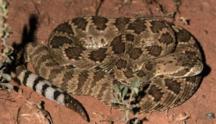
Mojave Rattlesnake As the name
says, this snake lives in the Mojave
Desert
of California. It can also be found in the extreme
western part of Texas, and Southern Nevada to
Puebla, near the southern edge of the Mexican
plateau. The Mojave
Rattlesnake lives mainly in the high desert and
lower mountain slopes. Its habitat may vary from
the dry desert to Adults can reach lengths of 2 to 4 feet, making it a medium-sized rattlesnake. The Mojave rattlesnake can easily be mistaken for the Western Diamondback rattlesnake (Crotalus atrox), which inhabits an overlapping range. They both have well-defined light-edged diamonds down the middle of their backs. The diamond pattern fades towards the last third of the Mojave Rattlesnake, whereas the diamonds continue to the tail in the Western Diamondback. The tail of the Mojave has contrasting light and dark rings. The white rings are much wider than the black rings, while the Diamondbacks have thick black rings. Some Mojave rattlesnakes are greenish, but can be colored greenish gray, olive-green, or occasionally brownish or yellowish. This rattlesnake has a very potent venom which is considered ten times more toxic than other North American rattlesnakes, a fact that makes the Mojave rattlesnake one of the most dangerous poisonous snakes in the United States. Their venom works as a neurotoxin and is called Mojave toxin. Strangely, the bite of a Mojave Rattlesnake is usually not as painful as other rattlesnake bites. The Mojave Rattlesnake does not lay eggs but gives live birth to several 9 to 11 inch young. It eats Kangaroo rats and other rodents. It is primarily nocturnal, hiding under crevice or in burrows during the hot day. The Mojave Rattlesnake is not listed as endangered or threatened. For a great
educational website on poisonous animals and toxins,
visit: 2001
bibliography: "Mojave Rattlesnake - Utah's Hogle Zoo", http://www.xmission.com/~hoglezoo/reptiles/morattle.htm "Mojave Rattlesnake", http://www.geocities.com/RainForest/Canopy/3408/Cscu.htm Sean P Bush, MD, FACEP, "Snake Envenomations, Mojave Rattle", http://www.emedicine.com/emerg/topic541.htm |