|
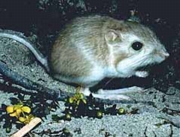
Desert Kangaroo Rat The
kangaroo rat is a very cute little critter that
kind of looks like a mini kangaroo, but is as big
as a mouse.It has large hind legs and feet. It
usually grow to about 14 inches (38 cm) in length,
including its tail. Its hair is a yellow buff color
above and white below. The tail has a white-tipped
tuft at the end. The thing that sticks out the most
is the Kangaroo rat's very big eyes. They live in large dens with wide openings which they dig themselves at the base of bushes, like creoste bush , or in the banks of wind drifted sand. There may be 6 to 12 entrances which they block off during the day. Their burrows are up to 4 1/2 feet (1.5 m) deep, with many passages which connect to food storage rooms and a nest chamber. The nest is made out of grass and other plants. It spends most of its day underground sleeping, and comes out to feed at night when it is cooler. The female kangaroo rat has 3 or more litters of babies a year which are born from January through June. She is pregnant for 29 to 32 days. The newborns weigh about 1/16 oz (3 g). The babies are weaned at 3 to 4 weeks. Their life span in the wild is 3 to 5 years. They are solitary creatures, only one animal occupies a burrow, and have territories of about 1/2 acre. The kangaroo rat moves exactly like a real kangaroo, but is not a real kangaroo. It is actually a rodent. They drum the ground with their hind legs and kick sand at objects, probably to see if its alive. The kangaroo rat mostly eats seeds, leaves, stems and insects. It has adapted to desert life by getting its water from the food it eats. Another great adaptation the kangaroo rat has is a cheek pouch, which it can store food in for weeks while finding shelter. Another is its big, long, fluffy tail. It uses its tail for balance and steering its way. The Kangaroo rat is the biggest of its kind and dominates other Dipodomys. Predators include coyotes, foxes, badgers, snakes, owls. The kangaroo rats are not endangered, and their status in the wild is very good right now. 2000.
bibliography: Photo credit: Jeff Foott Book of Mammals, National Geographic, Washington D.C. "Animal Biomes-Desertusa", www.desertUSA.com/animal.html, (June 5, 2000) "Animal Biomes" www.mbgnet.mobot.org/set/desert/index.html, (June 5, 2000) "BISON Species Account 050627", http://fwie.fw.vt.edu/states/nmex_main/species/050627.htm (8/23/)
|