|
Grey Fox The grey
fox can be found from Ontario, Canada, throughout
the central and southwestern United States down to
Venezuela. It also lives in the chaparral of
California and Mexico. It prefers wooded and brushy
areas of the southwestern, central and eastern
United States where most of the rainfall is in the
winter, while the summers are hot and dry. It is
not found in the Rocky Mountains, the Great Plains
or eastern central America. It disappeared from
Canada in the late 17th century, but lately they
have been found in southern Ontario, Manitoba and
Quebec. The grey
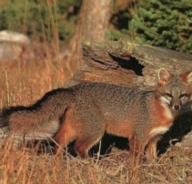
fox looks a lot like a small dog with a bushy tail.
The fox's back is whitish-grey in color. The sides
of its neck, the base of its tail, back and legs,
and the underside of its tail are bright rusty-red.
A black stripe runs along the top of its bushy
tail, which ends in a black tip. Its muzzle is
black and a black stripe goes from its eyes towards
its neck. The grey fox is 21 to 30 inches long, and
its tail is another 11 to 16 inches long. It stands
about 15 inches at the shoulder. The adult grey Fox
weighs 7 to 11 pounds. The grey
fox has short legs that are very powerful. These
legs are designed to give the fox tremendous
ability to balance itself while it climbs. Strong,
hooked claws allow them to pull themselves up tree
trunks and branches. The color of its fur hides it
from predators. The grey
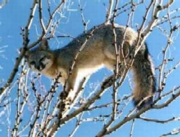
fox is the only member of the dog family that can
climb trees. It will climb a tree to escape its
enemies. It climbs by grabbing the trunk with its
forepaws and scrambling up with the long claws on
its hind feet. It can make its way through the tree
tops by jumping from branch to branch or shimmying
down backwards. It will also sit in the trees and
ambush prey. It is not a fast runner, but can reach
speeds of 28 mph. for short distances. Grey foxes
are nocturnal animals, and go back to their den
during the day. They are very territorial and mark
their boundaries with urine. Females reach maturity
at one year and breed from February to March. The
father, or dog fox, stays with the female until the
pups are born, and is then thrown out of the den by
the female. Usually 3
to 4 pups are born after 50 to 55 days. They are
dark brown and blind at birth and weigh 3.5 oz.
They open their eyes after 10 days. The mother
stops nursing the pups after 10 weeks. During this
time the father provides the whole family with
food. The family stays together during the fall,
but separate at the beginning of winter. grey foxes
are usually solitary during the winter. The grey
fox lives for 6 years in the wild and 12 years in
captivity. Grey foxes do not migrate. The grey
fox is a solitary hunter, and eats a lot of
different things such as berries, nuts, birds,
insects, rabbits and other rodents. The grey fox is
an omnivore. If it has more food than it can eat,
the fox will bury it and go back later. It will
mark the spot with urine so that it can find it
when it gets hungry. In the arid regions of the
chaparral it will eat more insects and plants than
foxes living farther east. The grey
fox has few predators besides man. Hawks, eagles,
owls, bobcats and dogs will kill and eat the pups.
Its ability to climb trees allows it to eat food
not eaten by the red fox. The grey
fox is plentiful in the wild. It often helps the
farmer by eating rodents. When the grey fox becomes
a pest by eating chickens and crops, the farmer
will shoot or trap it. by Brant S.
2002 Editor's
Note: One of our
readers wrote: I agree
completely. We should all become more sensitive to
the creatures we share our world with. To say that
the grey fox is plentiful in the wild does not mean
that it will be there forever if we don't take
actions to make sure of that.
bibliography: "Untitled", "grey Fox (Desert
USA)", "Urocyon
cinereoargenteus (grey Fox): Narrative", "Untitled", "Common grey
Fox", "grey Fox", "grey Fox Species
Account", "grey Fox", Wildlife Explorer, International Masters Publishers, USA 1998
|