|
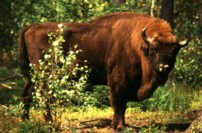
European Bison The story of the European bison, or wisent, is a
story of an amazing return from the brink of
extinction by a species. At one time, the bison
roamed the temperate European deciduous forest
biome from British Isles, through most of Europe
into Siberia. By the Middle Ages, in the 15th
century, the bison had become all but extinct in
many countries, and had died out entirely in
Czechoslovakia. They survived in the wild
into the 20th century
only in Poland and Caucasia, where they lived
protected and fed in royal hunting forests well
into the 18th century. A poacher shot the last wild
Polish bison in 1919, and last wild Caucasus bison
was killed in 1925. Only 54 bison remained in zoos
and private parks. Almost immediately, a drive was
organized to bring the bison back. In 1929, Poland
bought two cows and a bull from Sweden and Germany
and brought them to a breeding station in the
Bialowieza forest. During World War II the bison
were protected by both the Germans and the
Russians, when killing one became punishable by
death. The first two bulls were released into the
Bialowieza National Park in 1952, with several cows
following soon after. In 1957 the first calf was
born into the wild. Since 1980 more than 20 herds
have been reintroduced into Poland. Today the
largest concentration of European bison can be
found in Poland's Bialowieza National Park. The
park is a 20 square mile area located inside the
220 square mile Bialowieza Forest, and borders
Belarus' Beloveskaja Pusca National Park. A large
fence divides the forest along the border of the
two countries, and separates the herds from each
other. Currently their range includes Belarus,
Kyrgyzstan, Lithuania, Poland, Ukraine, and the
Russian Federation. The bison prefers flat, moist
deciduous or mixed forests. Temperatures in January
average 25° F in the Bialowieza Forest, and
the average snow cover lasts 92 days a year.
Traditionally the bison have been fed during the
winter, a practice that survives today. There are
two subspecies of Bison bonasus. The lowland bison
(Bison bonasus bonasus) consists of about 1,000
animals. Of these about 69% range freely in Poland,
Belarus, Russia, Lithuania, Romania, and the
Ukraine. The highland or Caucasus bison (Bison
bonasus caucasus) has been interbred with lowland
bison, and no true line remains of this species.
About 2,200 survive, of which about half live in
the wild. The bison
is the largest and heaviest mammal on the European
continent. They are smaller, and have longer legs
than the American bison. The hair on the back of
the neck is shorter, which also making them look
smaller than their American cousin. Even so, the
bulls can stand over 6 feet tall, and be over 9
feet long. Males are larger than females. A thick,
dark brown, shaggy mane covers the head, neck, and
front legs. In the autumn their coat becomes
thicker in anticipation of winter. Both males and
females have short horns that curve inward on the
males, but are straighter on the females. These
horns are permanent and don't branch off at any
point. In the
winter, the bisons form large mixed herds that stay
close to feeding stations. In the spring they break
up into smaller maternal and male groups. Maternal
groups consist of adult cows, calves and juveniles,
while the male groups consist of bachelor males.
Older males will often go their own way. The same
set of cows tend to stay together from year to
year. The bulls will stay in separate groups during
the calving season, and rejoin the mixed groups
during the rut, or mating season. During
mating season, which lasts from August to October,
a bull will move between groups looking for cows in
estrus. He will attend her for several days before
mating. During this time he will try to prevent any
other bull from getting near her. Some bulls are
severely injured during these head-butting bouts.
After mating, the bull will leave the cow to look
for another cow ready to mate. The pregnancy lasts
for about nine months, and the calves are born from
May to July. The mother leaves the herd to give
birth to her calf, which is able to run only hours
after it is born. The calf will nurse for about a
year, or until its mother has another calf. Cows
usually have a calf every year. bison reach sexual
maturity in three to four years. Their life
expectancy is up to 25 years. Unlike
their American cousins, who live on the open
grasslands of the Midwest, the European bison is a
woodland animal. It browses on deciduous trees,
leaves, twigs, young shoots, bark, and berries.
Favorite foods include willow, aspen, ash,
mistletoe, and blackberry. They will also eat
mushrooms, ferns, lichens, mosses, and acorns. In
the winter, the park personnel feed them oats, hay,
and sugar beets. According
to the 2000 IUCN Red Data List the European bison
is an endangered species, and is protected. One of
the largest threats to the European bison is
further reduction of their range. Another
significant threat is inbreeding. Since all the
bison alive today come from a small survivng core
group, there is not a great variety in the makeup
of their genes. This makes the bison susceptable to
diseases, decreases their life span, increases
juvenile mortality, and the intervals between the
birth of calves. The bison are also susceptabel to
the diseases of domestic cattle, like hoof and
mouth disease, pasturellosis, and
parasites.
bibliography: "European Bison
Biogeography", "European Wisent
Bison bonasus", "Nature Conservation
- European Bison (Bison bonasus)",
|