|
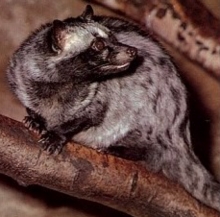
Common Palm Civet While
growing up in Indonesia, I would sometimes wake up
to a terrible racket in the ceiling, occasionally
followed by a sickly-sweet odor reminiscent of a
striped skunk. It was the musangs, or common palm
civets, having some sort of spat. Once one fell
through the ceiling, almost hitting my father, who
had gone to investigate. Like pesky squirrels they
would sometimes invade our attic. The common
palm civet is found from the Himalayas and southern
China, to the Philippines, the Malay peninsula, and
the Indonesian islands. It is a highly adaptive
animal and can live in dense
forests, agricultural areas, and even alongside
humans. Weighing
from 4 to 11 pounds, the palm civet's head and body
length is 17 to 28 inches (43.2-71 cm), with a tail
length of 16 to 26 inches (40.6-66 cm). Its ears
are small and faintly pointed, as is its nose. It
has a long and slender body with short legs. They
have a coarse grayish to brown coat with
black-tipped guard hairs over all. Three rows of
black spots run along each side of its body. The
hair around its eyes, cheeks and muzzle is black,
with spots of white under each eye and on each side
of its nose. The ears, feet and last end of its
tail are also black. Both sexes
have well-developed anal scent glands looking
somewhat like testes, which gives the musang its
species name. A nocturnal
omnivore, the palm civet hunts alone. They are
expert climbers and spend most of their lives in
trees. They eat small vertebrates, insects, ripe
fruits and seeds. They are very fond of palm sap,
therefore their common name. The sap is used by
natives to make a sweet liquor called "toddy",
which gives the palm civet its other common name.
The palm civet is also fond of coffee cherries.
They eat the outer fruit and the coffee beans pass
through their digestive tract. An expensive coffee
called kopi luwak is supposedly made from these
coffee beans. Kopi luwak is said to have a gamy
flavor and sells for more than $100 per
pound. Palm civets
stake out territories which often overlap during
times of adequate food supply. When spending time
in one area, musangs will use the same tree to
sleep in during the day. Plam civets reproduce
throughout the year although it has been recorded
that kittens are most often seen from October to
December. Kittens are born in a litter of 2 to 5
young. Palm civets become sexually mature at 11 to
12 months. In captivity the common palm civet can
live up to 22 years. The common
palm civet disperses seeds of the trees on which it
feeds by eating the seed pulp and passing the seeds
well away from its parent tree. Although not much
is known about the palm civet, it is believed that
its nocturnal habit was developed to avoid
predators. It is plentiful in its natural range and
is not endangered. 2002
bibliography: Shiroff, Adam. "Paradoxurus hermaphroditus (Palm Civet): Narrative", http://animaldiversity.ummz.umich.edu/accounts/paradoxurus/p._ hermaphroditus$narrative.html, 1/19/02 "Bankok Post Monday 19 November 2001 - fauna file", http://www.bangkokpost.net/en/191101_Outlook/19Nov2001_out9 7.html, 1/19/02 Lumpkin, Susan. "ZooGoer: Coffee and Palm Civet", http://www.fonz.org/zoogoer/zg1996/luwak.htm, 1/19/02 Nowak, Ronald M. "CARNIVORA; VIVERRIDAE;PARASOXURUS: Palm Civets, Musangs, or Toddy Cats", http://www.press.jhu.edu/books/walker/carnivora.viverridae.parad oxurus.html, 1/19/02 |