|
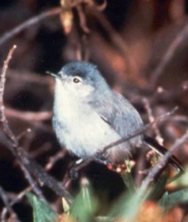
Coastal California Gnatcatcher The coastal
California gnatcatcher is an endangered bird which
only lives in the narrow coastal strip of sage
scrub of the California chaparral. It can be found
from southern Ventura County down to Baja
California, Mexico. The California coastal
chaparral is an endangered ecosystem. The winters
can be cold and humid, while the summers are hot
and dry. The average annual rainfall is between 6
and 20 inches. The coastal
California gnatcatcher is a small blue-gray
songbird which measures only 4.5 inches (11 cm) and
weighs 0.2 ounces (6 grams). It has dark blue-gray
feathers on its back and grayish-white feathers on
its underside. The wings have a brownish wash to
them. Its long tail is California gnatcatchers breed from February to late August, but most of the breeding occurs between mid-March and mid-May. It protects a territory of 5 to 49 acres (2 to 20 hectares) during breeding season. Most of the nests are built less than 3 feet (1 meter) off the ground. It takes about 14 days to incubate the eggs. The young birds fledge, or leave the nest, at 8 to 13 days. They are dependent on their parents for three to four weeks, but may stay with them for several weeks more. About 94% of the coastal California gnatcatcher live below elevations of 787 feet (240 m) along the coastal areas of the sage scrub chaparral. They are insectivores and feed on arthropods found in the vegetation of the sage scrub. They require large areas of sage scrub to maintain their diet. They prefer open growth which has has been burned about 8 to 9 years before, and avoid older, denser stands of sage scrub. With populations of the coastal California gnatcatcher declining rapidly, it was listed as threatened in 1993 under the Endangered Species Act of 1973. The coastal California gnatcatcher is known as an "umbrella species". In order to save the coastal California gnatcatcher, the coastal sage scrub chaparral needs to be saved. When the sage scrub chaparral is saved, countless plants and animals that live in that habitat will also be saved. Some scientists disagree with whether this conservation tactic is working. 2002
bibliography: "Untitled", "Wong, Kathleen.
"Seeing Stars; Spotty Shelter from Umbrella Species", "Californis
Gnatcatcher", "California
Gnatcatcher", "http://www.wminteractive.org/Articles/fr11-5.htm", |