|
Cactus Wren The Cactus
Wren lives in the arid and semi-arid deserts of
southwestern United States and the chaparral of
southern California and northern Mexico. The Cactus
Wren is usually found below 4,000 feet. The
California
chaparral
has hot and dry summers and humid and cold winters.
It normally gets about 6 inches of rain per
year. At 7-9
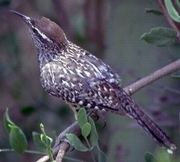
inches (18-22 cm) long, the Cactus Wren is the
largest wren in the United States. Both sexes look
alike. Both are brown and have a white stripe
running over each eye. Their
throats are white, and their beaks are dark, long
and slightly curved. White and black streaks cover
their backs. Their belly and sides are white to
buff with dense spotting on the breast. The short
and rounded wings have black and white banding.
Legs and feet are tan colored. They are
very active and curious birds. They quickly
investigate anything new in their territory. If you
leave your car windows down or the garage doors
open they are sure to enter and check it out
thoroughly. Cactus
Wrens like to breed in successional chaparral scrub
(chaparral that has recently come back from a
burn). The female will select a nesting site in
low, thorny trees or shrubs. In the Sonoran desert
they prefer the well protected branches of the
chain fruit
cholla.
Both male and female help build a football-shaped
nest of dry grasses lined with feathers or other
soft materials. A small side entrance protects the
nest from predators. Cactus Wrens will first breed
from February to early March and continue to have
more broods through June if conditions are right.
Four or five buff colored eggs speckled with brown
are laid at one time. The size of the clutch
(amount of eggs laid) is determined by the food
supply. This is an adaptation Cactus Wrens have
made to the changing food availability in their
desert and chaparral habitats. The female incubates
the eggs for 16 days while the male builds several
more nest throughout his territory for roosting and
future nesting sites. After the eggs hatch both
parents will feed the hatchlings. The young fledge,
or leave the nest, in 19 to 23 days. The fledglings
stay with their parents for about a month.
Cactus
Wrens don't migrate and are considered permanent
residents of the region they live in. Males will
vigorously defend their territory throughout the
breeding season. They sing territorial songs,
although the songs are not very musical. The song
consist of a one-pitched monotone of chuh,chuh,
chuh, chuh, gaining speed towards the end.
The Cactus
Wren mainly eats insects like ants, beetles,
grasshoppers, wasps, fruits, seeds, and and
sometimes a treefrog or lizard. It will sometimes
eat seeds and fruit. It has adapted to its hot
habitat by shifting its foraging behavior according
to the temperature. It begins to forage on the
ground, and in the branches of shrubs in the late
morning. As the temperature rises it will shift its
foraging to shady, cooler areas. They stop foraging
during the hot afternoon and rest in a shady area.
They get almost all of their water from the food
they eat. The
California chaparral, home to the Cactus Wren on
the west coast, is quickly disappearing because of
development and urbanization. Only small patches of
true chaparral are left. Most of the remaining
chaparral isn't large enough to sustain a Cactus
Wren population. Cactus Wrens prefer the low,
thorny bushes and scrub of the chaparral to build
their nests because it protects their broods from
predators such as snakes. The Cactus Wren is very
adaptable to changing environments, as long as
native chaparral plants are provided to build its
rather large nests in. The Cactus
Wren is not considered endangered or threatened
throughout its range. However, like all songbirds,
it is protected by the Migratory Bird Treaty
Act. 2002
bibliography: "Cactus Wren",
http://www.mbr-pwrc.usgs.gov/id/framlst/i7130id.html, "Cactus Wren", http://www.scenicdrive.org/cgwren.htm, (May 5, '02). McCarthey, Tracy D. "AZGF Nongame Field Notes - Cactus Wren", http://www.gf.state.az.us/frames/fishwild/ngame_c.htm, (May 5, '02). Peterson, Lara. "Campylorhynchus brunneicapillus (Cactus Wren): Narrative", http://animaldiversity.ummz.emich.edu/accounts/campylorhynchus/c._ brunneicapillus$narrative.html, (May 5, '02). "Wild
World@nationalgeographic.com",
|