|
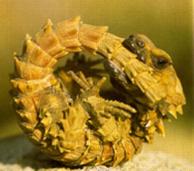
Armadillo Lizard The
nostrils of the Armadillo Lizard are formed into
little tubes. The tubes help the Armadillo Lizards
smell for food or predators. A ground dwelling
lizard, it is active in the daytime and feeds on a
wide variety of insects, as well as on spiders and
other invertebrates. The head of the Armadillo
Lizard is narrow in shape. It is fairly slow moving
animal, but when the Armadillo Lizard thinks or
knows it's in danger, it runs as fast as it can go
for cover. The Armadillo Lizard has its babies in the late summer. Only 1 or 2 babies are born during that time. The Armadillo Lizards stay in family groups, and they will all live in the same rock crevice. When the lizards give birth, the babies are live-born, but do have a thin membranous shell that they need to break through. The Armadillo Lizard is a prey animal. It is preyed upon by bigger and stronger predators, such as humans, etc. The Armadillo Lizard's armor is most usefull against many birds, mammals, and other reptiles. The Armadillo Lizard is not an endangered species although it does have a lot of enemies to protect itself from. The Cape Provincial Ordinance helps the Armadillo Lizards when their injured or sick. That way the Armadillo lizards can be less endangered. Zach S. 2001
bibliography: "Desert Biome.", http://mbgnet.mobot.org/sets/desert/animals/arma.htm. "Cordylus
Cataphractus.", http://home.swipnet.se/tallbo/andra_cordylus/cordyluscataphractu "Lizards of the World; Armadillo.", http://www.discovery.com/exp/lizards/low_armadillo.html "Reaction to
danger", http://www.britannica.com/eb/article?eu=118991&hook=421391#4 Photo credit: Pictures from Bill Branch´s "Field Guide to the Snakes and other Reptiles of Southern Africa."- Cape Town : Struik Publishers,326s, BRANCH WILLIAM R.(1988g), page 157 - 164.
|