|
Swift Fox The story of this
beautiful, delicate swift fox is the story of an
animal, which almost didn't make it back from the
edge of extinction. The swift fox was considered so
common on the Great Plains of Canada and the United
States, that its gradual disappearance was almost
overlooked by conservationists and governments. The
last swift fox was sighted in Saskatchewan in 1930,
and in the space of a few decades, it had
disappeared from most of its range in Canada. In
the United States it had been wiped out of 90% of
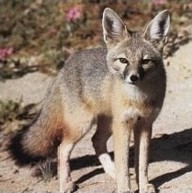
its range by the 1990s. The swift fox is a small,
delicate fox, the smallest wild canid of the North
American Continent, and a cousin of the western
desert kit
fox. It is about the size
of a cat, standing 12 inches (30 cm) in height, and
31 inches (79 cm) in length from head to tail. It
weighs approximately 5 lbs (2.3 kg). The male, or
dog fox, is larger than the female, known as a
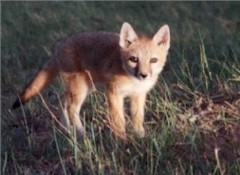
vixen. They are a dark buff gray
in color with a yellow-tan color across their sides
and legs. Their throat, chest, and belly are pale
yellow to white. They have black patches on their
muzzles and a black tip to their tail. Their ears
are noticeably large. The swift fox gets its name
because it can reach speeds of 25 miles (40 km) per
hour. Swift foxes are considered
nocturnal, doing most of their hunting in the
evening, through the night and into the early
morning hours. Although they are very sociable,
they keep one mate throughout their lifetime. They
don't appear to be territorial, with many of their
home ranges overlapping. Their dens are used daily,
all year long. The swift fox is
omnivorous and has a varied diet of rabbits, mice,
birds, reptiles, insects, berries, and seeds. Its
main source of food consists of prairie dogs and
ground squirrels. Predators of the swift fox are
coyotes, eagles, hawks, and man. Coyotes are the
primary predator of the swift fox. Swift fox pairs
get together and breed from February to
early May. The pregnancy lasts about 52
days. Litter size is about 4 to 5 pups.
The pups stay inside the den and don't
come out for about 3 to 4 weeks. At 6 to 7
weeks they are weaned and accompany their
parents on the hunt. They will stay with
their parents until they are about 4 to 5
months old. In September they all go their
separate ways. Swift foxes When settlers first moved
west onto the Great Plains, the swift fox could be
found ranging north to south from central Alberta,
Canada, to central Texas, and east to west from
western Iowa and Minnesota through New Mexico,
Colorado, Wyoming and Montana. The swift fox occupies a
specialized niche in its environment, relying on
the open, rolling short and mixed-grass prairies on
which buffalo range, prairie dog burrows, and the
prairie dogs and ground squirrels on which they
feed. After the near annihilation of the bison, the
grasses grew tall and the little swift fox was
unable to scan for predators. Mass poisoning of
prairie dog towns to make way for agriculture
eliminated the swift fox's main prey of prairie
dogs and ground squirrels. Most devastating was the
loss of prairie dog burrows used by the swift fox
for their whelping dens and escape from predators.
Without the safety of the burrows, the swift fox
became easy prey for coyotes and golden eagles.
Slowly the swift fox was sighted less and less.
Today they are considered
to be "endangered" by the Committee on the Status
of Endangered Wildlife in Canada. Private and
government efforts are making gradual progress in
reintroducing the swift fox to some of their
natural range. In the United States the
swift fox was not considered endangered under the
federal Endangered Species Act, although only 10%
of its original population survived in isolated
areas. In 1995 the U.S. Fish and Wildlife Service
said that the swift fox should probably be listed,
but that the listing could put restrictions on the
way the land was used. Ranchers and farmers were
afraid they could no longer use the land designated
to the swift fox. The Swift Fox Conservation Team
was established to look into ways to slow down the
decline of the existing swift fox populations.
Northern Prairie Wildlife
Research Center is helping in the reintroduction of
swift foxes on the Blackfeet Tribal lands in
Montana, and giving advice in the re-introducing
the swift fox into Badlands National Park and the
Bad River Ranch in South Dakota. In 1998 the Blackfeet
Nation of Montana, together with the Cochrane
Ecological Institute and the Defenders of Wildlife
began a restoration project of the swift fox to
Montana. The Institute had the only swift fox
captive-breeding facility in the world. While the
Defenders of Wildlife provided the funding for the
project, the Blackfeet Nation provided the land. By
the year 2002, 10 dens had been documented, and the
population was growing. In addition to returning
the swift fox to the land, efforts were also made
to re-establish the swift fox's food source of
prairie dog and black-footed ferret populations.
Their goal is to establish a self-sustaining
population of swift foxes in the region. After determining that
re-establishing the swift fox would not have an
adverse effect on nearby ranchers, The Badlands
National Park in South Dakota released 30 swift
foxes from Colorado into the park in August of
2003. Their aim is to release 30 swift foxes a year
into the park and the surrounding Buffalo Gap
National Grasslands until 2005. There are already
large prairie dog towns and other rodent
populations that will provide shelter and food for
the swift fox to get established. Private efforts are also
proving very successful. Ted Turner, the owner of
several large bison ranches in South Dakota and a
member of the Swift Fox Conservation Team, set up
the Turner Endangered Species Fund. In 2002 swift
foxes were introduced to his 138,000-acre Bad River
Ranch, just east of the Badlands National Park.
Studies showed that the ranch could support a
self-sustained population of 200 swift
foxes. The Livestock Advisory
Board approved the return of the swift fox to the
Bad River Ranch. The South Dakota Stockgrowers
however, have voiced concern that approving the
plans could set a precedent for the later
introduction of larger carnivores like wolves and
grizzly bears. Biologist Mike Phillips, who oversaw
the reintroduction of wolves to Yellowstone Park in
the 1990s, says, "Badlands and Bad River are the
first beach heads, but for this to work, you've got
to have more than beach heads. You need human
cooperation. You can have all the habitat in the
world, yet unless people are willing to consciously
make room for wildlife in their daily lives, we'll
continue to repeat the old patterns that caused
problems."
bibliography: "Swift Fox",
(on-line), accessed on 10/14/04 at "Defenders of
Wildlife- Wildlife - Swift Fox", (on-line) accessed on
8/24/04 at "Narional Park
Service - Natural Resource Year in Review - 2003"
(on-line), "Return of the Swift
Fox" (on-line), accessed on 10/17/04 at
|